The Briefing
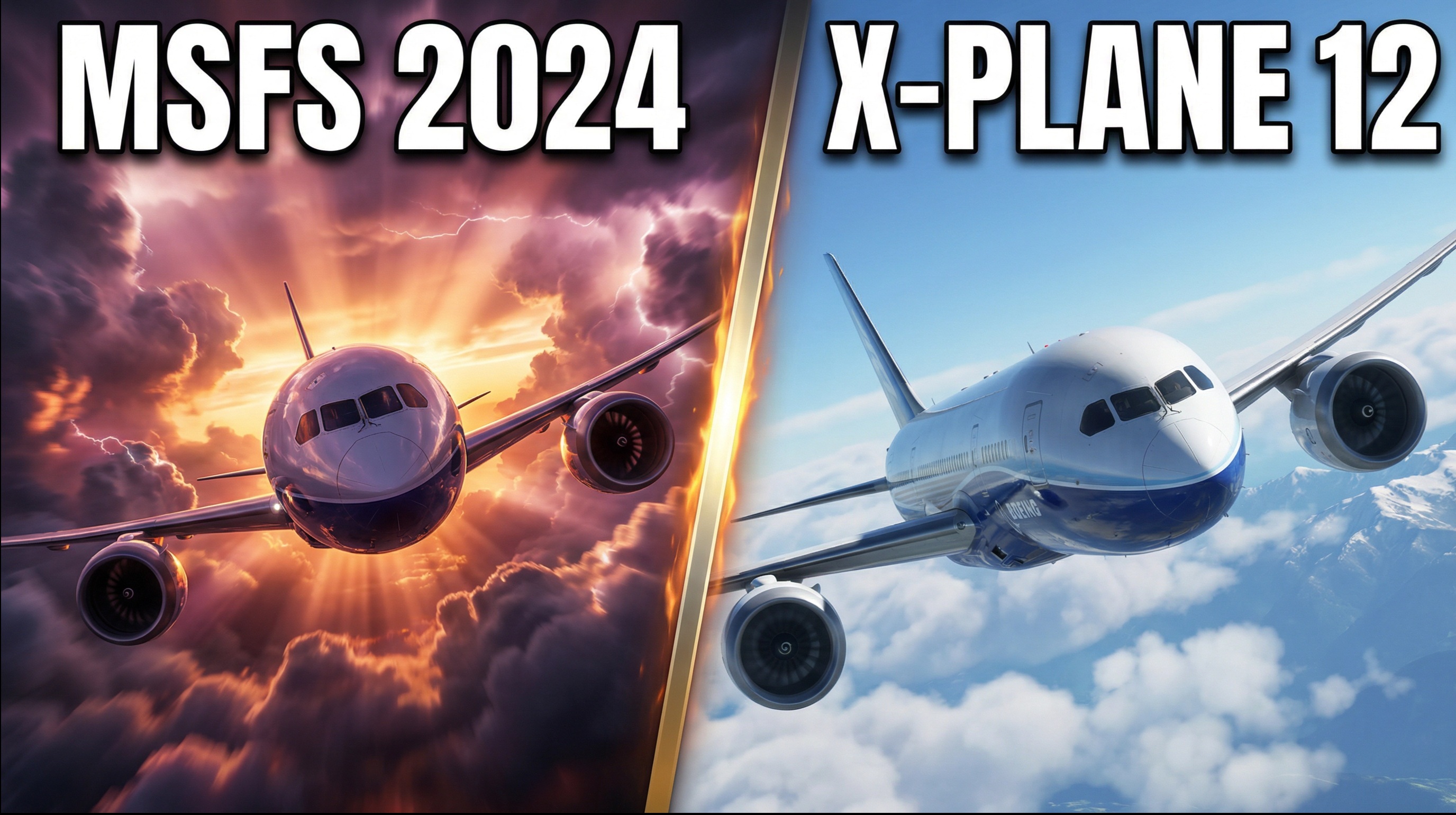
The flight simulation community has never been more divided—or more passionate. Microsoft Flight Simulator 2024 launched with stunning visuals and ambitious features, while X-Plane 12 continues refining its physics-first approach. Both have devoted followings. Both claim superiority. Neither tells the complete story.
After extensive time in both simulators across multiple aircraft types, system configurations, and flight scenarios, I'm presenting an objective comparison. No fanboy bias. No sponsorship influence. Just honest analysis of where each platform excels and where it disappoints.
What you'll learn:
- ▸Core philosophical differences that drive each simulator's design
- ▸Graphics and visual fidelity comparison (it's more nuanced than you think)
- ▸Flight model accuracy and physics implementation
- ▸Scenery quality, world detail, and airport fidelity
- ▸Aircraft variety, system depth, and study-level options
- ▸Performance requirements and optimization
- ▸Community support, add-ons, and long-term value
If you're trying to decide between these platforms—or justify owning both—this briefing will give you the clarity you need.
The Fundamental Difference: Philosophy
Before comparing features, understand this: X-Plane 12 and MSFS 2024 were designed to solve different problems.
X-Plane 12: Physics-First Simulation
Core philosophy: Calculate how aircraft behave based on geometry and physics laws.
Design priority: Authentic flight dynamics that emerge from aerodynamic principles rather than pre-programmed behaviors.
Target audience: Pilots seeking training value, developers testing experimental aircraft, enthusiasts who want to understand why aircraft behave as they do.
Validation: FAA-certified for logging actual flight training hours.
This physics-first approach means X-Plane can predict behavior of aircraft that have never been flight-tested. The simulator doesn't need lookup tables—it calculates forces on every surface, 15+ times per second, using Blade Element Theory.
MSFS 2024: Immersion-First Experience
Core philosophy: Create the most visually stunning, accessible flight experience possible.
Design priority: Photorealistic graphics, seamless worldwide scenery, intuitive accessibility for newcomers.
Target audience: Aviation enthusiasts who want to explore the world, casual pilots seeking beautiful experiences, content creators needing visual impact.
Validation: Partnership with real airlines and aircraft manufacturers for authentic cockpit recreation.
MSFS 2024 leverages Azure cloud infrastructure and Bing satellite imagery to render a living world with real-time weather, air traffic, and environmental detail that was impossible five years ago.
The reality: Neither approach is "better"—they optimize for different priorities. Understanding this prevents endless Reddit arguments.
Graphics and Visual Fidelity: The Obvious Comparison
Let's address what everyone notices first.
MSFS 2024 Wins: Overall Visual Presentation
No contest here. Microsoft Flight Simulator 2024 is the most visually stunning flight simulator ever created. Period.
Where MSFS 2024 dominates:
- ▸Photorealistic terrain derived from satellite imagery
- ▸Volumetric clouds with realistic light scattering and shadows
- ▸Dynamic real-time lighting with accurate sun angles and twilight gradients
- ▸Detailed landmarks and autogen buildings worldwide
- ▸Reflections, rain effects, and environmental interaction
- ▸Cinematic quality that makes screenshots indistinguishable from photographs
When you're flying VFR over your hometown or exploring exotic locations, MSFS 2024 delivers jaw-dropping immersion. The sense of actually being there is unmatched.
X-Plane 12 Counters: Consistency and Performance
X-Plane 12's graphics have improved dramatically from version 11, but they remain a generation behind MSFS 2024's peak visuals.
Where X-Plane 12 holds ground:
- ▸More consistent performance across diverse hardware
- ▸Less reliance on internet connectivity for acceptable visuals
- ▸Superior lighting in cockpit instruments and systems
- ▸Better default night lighting at airports
- ▸More predictable VR performance
- ▸Cleaner default UI that doesn't obscure instruments
X-Plane 12 adopted a modern metal-based rendering engine and improved atmospheric effects. It looks genuinely good in 2024. But "genuinely good" doesn't compete with MSFS 2024's "absolutely spectacular."
Honest assessment: If visual fidelity is your top priority, MSFS 2024 wins decisively. If you need consistent performance and cockpit clarity, X-Plane 12 is more reliable.
Flight Model and Physics: Where It Gets Interesting
This is where the philosophical difference matters most.
X-Plane 12 Wins: Physics-Based Flight Dynamics
X-Plane's Blade Element Theory approach creates flight characteristics that emerge from aerodynamic principles:
Authentic emergent behavior:
- ▸P-factor, torque, and spiraling slipstream develop naturally from propeller physics
- ▸Configuration changes (flaps, gear, speed brakes) affect multiple flight characteristics realistically
- ▸Asymmetric thrust in multi-engine operations feels authentic
- ▸Crosswind ground handling, especially in tailwheel aircraft, is remarkably accurate
- ▸Stall characteristics emerge from wing planform and mass distribution
Why this matters for training:
When you learn proper rudder use during high-power takeoffs in X-Plane, you're compensating for real propeller physics. When you manage an engine failure in a multi-engine aircraft, the yaw isn't scripted—it's calculated from asymmetric thrust and propwash.
Where X-Plane 12 struggles:
- ▸Transonic flight (Mach 0.8-1.2) uses empirical approximations rather than full physics
- ▸Helicopter modeling is less refined than dedicated helicopter simulators
- ▸Some aircraft require "tuning" to match real-world data perfectly
- ▸Ground friction modeling can feel inconsistent on certain surfaces
MSFS 2024 Counters: Refined Table-Based Modeling
MSFS 2024 uses sophisticated aerodynamic tables derived from real flight test data and wind tunnel testing.
Where MSFS 2024 excels:
- ▸Modern airliners feel authentic in normal flight regimes
- ▸Turbulence and atmospheric effects are beautifully integrated
- ▸Stall behavior in certified aircraft matches real-world characteristics
- ▸The new CFD (Computational Fluid Dynamics) foundation improves authenticity
- ▸Helicopter flight model has improved significantly in 2024
Where MSFS 2024 falls short:
- ▸Propeller effects (P-factor, propwash) feel muted compared to reality
- ▸Aircraft behavior outside tested flight envelopes is less predictable
- ▸Multi-engine asymmetric thrust doesn't feel as authentic
- ▸Configuration changes sometimes lack the interconnected effects real aircraft show
Honest assessment: For general aviation and propeller aircraft, X-Plane 12's physics feel more authentic. For airline operations in modern jets, MSFS 2024's refined tables are excellent. For helicopters, it's closer than it used to be—slight edge to MSFS 2024 in 2024.
Scenery and World Detail: The Game-Changer
MSFS 2024 Dominates: Worldwide Photorealistic Coverage
This is MSFS 2024's killer feature and the reason it's attracted millions of users who never considered flight simulation before.
The achievement:
- ▸Satellite-derived photogrammetry for major cities and landmarks
- ▸Autogen buildings that reflect local architecture worldwide
- ▸Real-time weather integration with visible precipitation, clouds, and wind effects
- ▸Dynamic world features: wildfires, seasons, changing snow coverage
- ▸Seamless streaming of terrain data eliminates loading times
You can fly from your hometown to any location on Earth with realistic terrain underneath. The sense of exploration is intoxicating.
Current limitations:
- ▸Stream quality varies by region (developed countries look better)
- ▸Internet dependency can be problematic in areas with poor connectivity
- ▸Some locations show satellite imagery artifacts or outdated data
- ▸Local caching requires significant storage for offline capability
X-Plane 12 Responds: Consistency and Customization
X-Plane 12 takes a traditional approach: ship with decent global coverage and let the community enhance specific areas.
What X-Plane 12 offers:
- ▸Solid baseline scenery with believable terrain mesh
- ▸Excellent default airports with proper layouts and taxiways
- ▸OpenStreetMap integration for roads and buildings
- ▸Complete offline capability—no internet required after installation
- ▸Easier scenery customization for specific locations
- ▸Community scenery packages often exceed default MSFS quality
Honest reality: MSFS 2024 changed what flight simmers expect from global scenery. X-Plane 12's default worldwide coverage is acceptable but unremarkable. However, with community add-ons for your preferred regions, X-Plane can look spectacular while maintaining performance.
Verdict: MSFS 2024 wins for exploration and variety. X-Plane 12 wins for offline reliability and localized detail with add-ons.
Aircraft Variety and System Depth
X-Plane 12 Leads: Study-Level Aircraft Availability
The X-Plane ecosystem has more deeply-simulated study-level aircraft than any other platform.
Standout examples:
- ▸**FlightFactor/Felis aircraft** (767, 757, A320): Systems modeled down to individual circuit breakers
- ▸**Toliss A319/A321/A340**: Airline-grade Airbus systems with authentic failures
- ▸**IXEG 737 Classic**: Every switch, knob, and system behaves authentically
- ▸**Zibo 737 (freeware)**: Arguably the best freeware airliner in any simulator
- ▸**General aviation study aircraft**: RealSimGear, SimCoders, Airfoillabs produce remarkable GA aircraft
Why X-Plane attracts developers:
The consistent physics foundation means developers can focus on systems without fighting unpredictable flight models. The result is aircraft where every system interaction is modeled.
MSFS 2024 Counters: Official Partnerships and Variety
MSFS 2024 launched with impressive variety and has been adding aircraft steadily.
What MSFS 2024 offers:
- ▸Stunning default aircraft with beautiful cockpits
- ▸Official partnerships with manufacturers (Boeing, Airbus, Cessna, Beechcraft)
- ▸Growing third-party market: PMDG, Fenix, iniBuilds, Aerosoft
- ▸Helicopter variety improving with each update
- ▸Warbirds and vintage aircraft receiving attention
Current reality:
Study-level aircraft in MSFS 2024 are excellent but fewer in number. PMDG's 737 is spectacular. Fenix's A320 is outstanding. But the overall depth of systems simulation across the entire aircraft catalog doesn't yet match X-Plane's mature ecosystem.
Verdict: For study-level systems depth and variety, X-Plane 12 currently leads. MSFS 2024 is catching up rapidly with top-tier payware but hasn't achieved parity yet.
Performance and Hardware Requirements
The Complicated Truth: Both Are Demanding
MSFS 2024 requirements:
- ▸GPU-heavy: Demands high-end graphics cards for optimal visuals
- ▸RAM-intensive: 32GB recommended for smooth streaming
- ▸Storage: Minimal base install, but caching scenery requires hundreds of GB
- ▸CPU: Benefits from strong single-thread performance
- ▸Internet: Meaningful impact on scenery quality and features
Performance reality: MSFS 2024 can be tuned for mid-range systems but requires compromises. Peak visual quality demands cutting-edge hardware.
X-Plane 12 requirements:
- ▸More CPU-dependent due to physics calculations
- ▸Moderate GPU requirements compared to MSFS
- ▸20-30GB storage for base install
- ▸Benefits significantly from high refresh rate displays
- ▸No internet required for full functionality
Performance reality: X-Plane 12 runs reasonably on mid-range systems. VR performance is more predictable. You sacrifice visual spectacle but gain consistency.
Verdict: X-Plane 12 is more forgiving of modest hardware. MSFS 2024 rewards powerful systems with breathtaking visuals.
Community, Add-Ons, and Ecosystem
X-Plane 12 Advantages: Mature Ecosystem
Community strengths:
- ▸X-Plane.org hosting thousands of free and payware add-ons
- ▸Easy scenery installation with straightforward folder structure
- ▸Active freeware developer community
- ▸Modular design allows deep customization
- ▸Plugin architecture enables extensive capability additions
Challenges:
- ▸Fragmented resources across multiple websites
- ▸Quality varies dramatically between add-ons
- ▸Some developers abandoned X-Plane when MSFS 2020 launched
MSFS 2024 Advantages: Unified Marketplace
Community strengths:
- ▸Integrated marketplace with quality control
- ▸Massive user base attracts developers
- ▸One-click installation for most add-ons
- ▸Active development from major payware studios
- ▸YouTube and streaming content exposes new users to capabilities
Challenges:
- ▸Add-on prices trend higher than X-Plane equivalents
- ▸Marketplace curation sometimes rejects quality freeware
- ▸Some complex add-ons struggle with installation outside marketplace
Verdict: X-Plane 12 has a more mature, if less organized, ecosystem. MSFS 2024's unified marketplace is convenient but more expensive.
VR Experience: Critical for Immersion Seekers
X-Plane 12: Optimized VR Performance
VR strengths:
- ▸More consistent frame rates in VR headsets
- ▸Lower hardware requirements for acceptable VR experience
- ▸Better cockpit instrument clarity at lower render scales
- ▸Predictable performance tuning for VR optimization
VR limitations:
- ▸Visual detail doesn't match MSFS 2024's peak capability
- ▸Exterior views less impressive in VR
MSFS 2024: Stunning but Demanding VR
VR strengths:
- ▸Absolutely breathtaking scenery and clouds in VR
- ▸Sense of scale and immersion is unmatched
- ▸Photorealistic terrain makes VFR magical
VR limitations:
- ▸Requires extremely powerful hardware for smooth performance
- ▸Frame rate inconsistency can cause discomfort
- ▸Difficult to maintain high refresh rates at acceptable visual quality
Verdict: X-Plane 12 for smooth, comfortable VR sessions. MSFS 2024 for jaw-dropping visual moments if you have the hardware.
The Strengths Summary
Choose X-Plane 12 When You Want:
- ▸Authentic physics-based flight dynamics
- ▸FAA-recognized procedural training
- ▸Study-level aircraft with deep systems simulation
- ▸Consistent VR performance
- ▸Complete offline capability
- ▸Mature add-on ecosystem
- ▸Propeller aircraft realism
- ▸Freedom to modify and customize extensively
Choose MSFS 2024 When You Want:
- ▸Breathtaking photorealistic visuals
- ▸Worldwide exploration with seamless scenery
- ▸Accessible learning curve for newcomers
- ▸Modern airliner experiences
- ▸Real-time weather and dynamic world features
- ▸Unified marketplace convenience
- ▸Content creation and screenshot opportunities
- ▸Growing developer support and official partnerships
The Weaknesses Reality Check
X-Plane 12's Genuine Shortcomings:
- ▸Dated default user interface
- ▸Global scenery looks mundane compared to MSFS
- ▸Steeper learning curve for new sim pilots
- ▸Graphics don't compete with MSFS's peak visual quality
- ▸Fewer "wow factor" moments for casual flying
- ▸Some legacy design decisions feel antiquated
MSFS 2024's Real Problems:
- ▸Internet dependency compromises reliability
- ▸Propeller aircraft physics feel muted
- ▸Performance optimization is frustrating
- ▸Some features feel half-finished or abandoned
- ▸Bugs persist longer than users expect
- ▸Heavy system requirements exclude budget hardware
- ▸Physics behaviors in edge cases can be unpredictable
The Money Question: Value Proposition
X-Plane 12: $60 Base
- ▸Includes decent base aircraft
- ▸No subscription required
- ▸Free updates within version 12
- ▸Freeware add-ons provide excellent value
- ▸Study-level aircraft cost $50-100 typically
MSFS 2024: $70-130 Depending on Edition
- ▸Stunning base package
- ▸Optional Game Pass subscription for access
- ▸Marketplace add-ons priced premium
- ▸Study-level aircraft cost $70-150 typically
- ▸Scenery often included in base or cheap
Honest assessment: Both require investment for optimal experience. MSFS 2024's base package offers more initial "wow," but X-Plane 12's ecosystem provides better long-term value for training-focused pilots.
The Controversial Opinion: You Might Need Both
Here's what I actually do:
X-Plane 12 for: - Procedural training and pattern work - General aviation flying where physics matter - IFR practice and approach procedures - Multi-engine training and emergencies - Anything requiring authentic flight dynamics
MSFS 2024 for: - Long-haul airline flights with spectacular scenery - VFR exploration of new locations - Flying with non-pilot friends who want pretty visuals - Content creation and screenshots - Casual evening flights for pure enjoyment
Different tools for different missions. Neither is perfect. Both have legitimate value.
The Real Question: What's Your Priority?
If you're a pilot, student pilot, or aviation enthusiast seeking training value: X-Plane 12 is the clear choice. The physics authenticity translates directly to real flying.
If you're an aviation enthusiast wanting to explore the world and experience flight: MSFS 2024 offers unmatched immersion and accessibility.
If you're a hardcore systems nerd who wants study-level aircraft: X-Plane 12's ecosystem currently offers more depth.
If you're new to flight simulation and want something approachable: MSFS 2024's tutorials, accessibility, and visuals provide a gentler entry.
If you value consistent performance and offline capability: X-Plane 12 removes internet dependency and performance uncertainty.
If you want the most photorealistic experience possible: MSFS 2024 is the undisputed champion.
Pro Tips for Either Platform
For X-Plane 12 users:
- 1.Invest in good add-on scenery for your local area—it transforms the experience
- 2.The Zibo 737 (free) provides incredible value for airline operations
- 3.Use XPRealistic plugin for improved immersion
- 4.Tune your rendering settings for smooth performance rather than max quality
- 5.Join X-Plane.org forums for community knowledge
For MSFS 2024 users:
- 1.Use developer mode to monitor performance and identify bottlenecks
- 2.Adjust terrain and object detail based on your hardware capabilities
- 3.Download offline areas for locations you fly frequently
- 4.Join MSFS Discord communities for real-time support
- 5.Use content manager to control installed add-ons and manage storage
For both:
- ▸Start with simpler aircraft before jumping to complex airliners
- ▸Use online networks (VATSIM/PilotEdge) to add realism and structure
- ▸Invest in quality hardware (yoke, rudder pedals, throttle quadrant) before expensive software
- ▸Study real procedures and charts—authenticity comes from knowledge, not just software
- ▸Remember that perfect simulation doesn't exist—understand the limitations
The Verdict: There Isn't One
This isn't a cop-out—it's honest assessment.
X-Plane 12 is objectively superior at: - Physics-based flight dynamics - Study-level aircraft systems depth - Propeller aircraft authenticity - Consistent performance - Training value
MSFS 2024 is objectively superior at: - Visual fidelity and graphics quality - Worldwide scenery coverage - Accessibility for newcomers - Integrated marketplace convenience - Exploration and variety
The "better" simulator depends entirely on what you value most.
I use both regularly for what each does best. When I want authentic flight dynamics and procedural practice, X-Plane 12 is my choice. When I want to explore new locations or fly a relaxing evening route with stunning visuals, MSFS 2024 delivers experiences X-Plane can't match.
The flight simulation community has two world-class options serving different needs. That's not a problem to solve—it's a luxury to celebrate.
Choose based on your priorities. Be honest about what you actually fly. Ignore the tribalism.
Both simulators will make you a better pilot and provide countless hours of enjoyment. The only wrong choice is refusing to acknowledge each platform's genuine strengths.
Watch On the Channel